
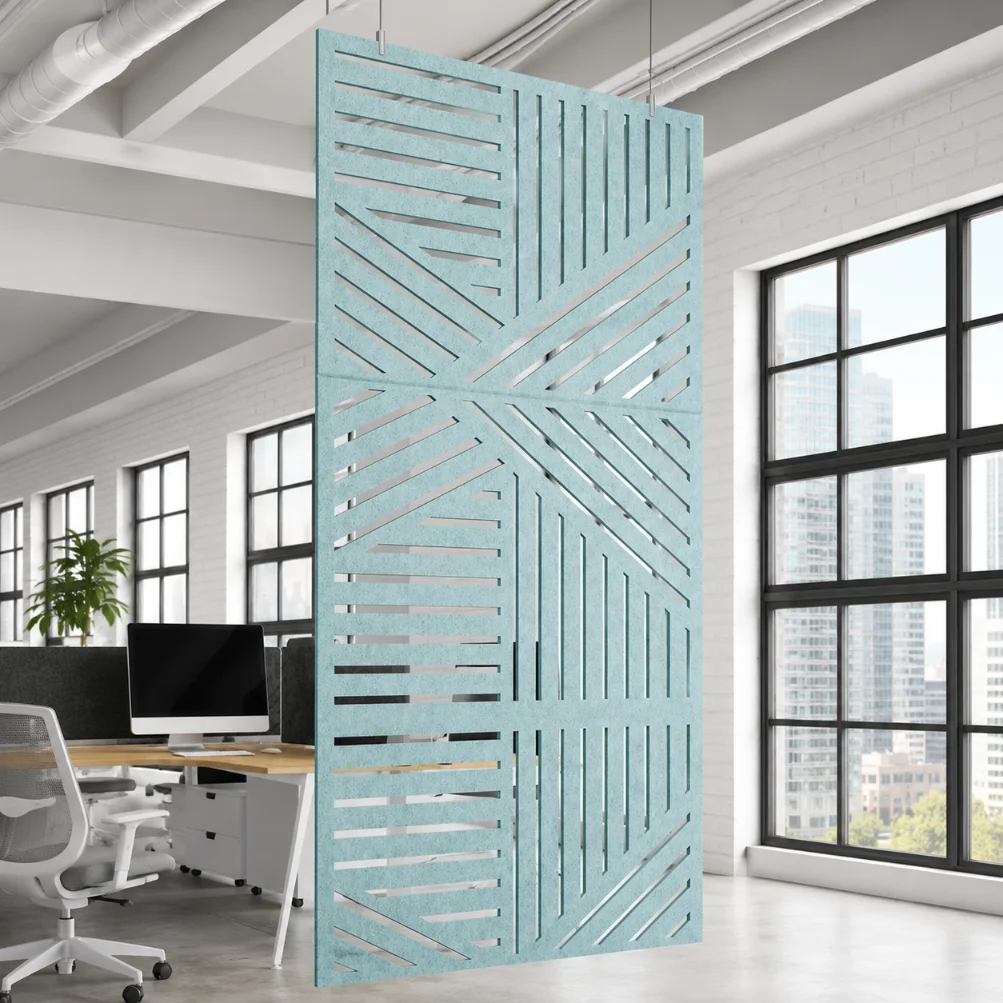
In the fast-paced world of commercial interior design, the modern office layout is undergoing a radical shift. The trend of expansive open-plan layout, towering exposed concrete ceilings, and sleek glass partitions continues to dominate. Yet, this visual grandiosity brings a persistent, unseen enemy: acoustic chaos.
For decades, the default remedy for corporate noise control was traditional acoustic drywall (sound-rated gypsum boards layered with mineral wool insulation). However, a new champion has quietly disrupted the commercial fit-out sector.
Today, forward-thinking architects and facility managers are moving away from messy, rigid drywall installations. Instead, they are opting for PET Felt Acoustic Panels.
Here is an analytical breakdown of why PET felt panels—such as the high-density architectural solutions engineered by HENGJIU Felt—are rapidly replacing traditional acoustic drywall in modern office fit-outs.
1. Speed of Installation: Days vs. Weeks
In commercial real estate, time is quite literally money. Every extra week an office space sits in the “under construction” phase costs the tenant lost productivity and expensive lease holding costs.
The Acoustic Drywall Nightmare: Installing acoustic drywall is a labor-intensive, multi-stage marathon. It requires framing heavy steel studs, packing loose mineral wool, hanging heavy boards, taping, mudding, sanding, priming, and painting. The debris, dust, and continuous VOC paint odors require extended downtime before the space can be safely occupied.
The PET Felt Revolution: PET felt panels are lightweight, highly rigid, and structurally self-supporting. Systems like HENGJIU’s 12mm or 24mm acoustic panels can be mounted directly onto existing walls using eco-friendly, zero-VOC water-based adhesives or simple mechanical clip tracking. There is zero sanding, zero paint smell, and zero dust. A typical conference room can be acoustically retrofitted over a weekend, resulting in absolute zero downtime for corporate operations.
2. Acoustic Efficiency: Absorption vs. Reflection
To properly manage sound, one must understand the difference between soundproofing (blocking noise from moving between rooms) and sound absorption (controlling echo inside a room).
| Material Attribute | Traditional Acoustic Drywall | HENGJIU PET Felt Panels |
| Primary Mechanism | Reflection & Containment (Mass) | Broadband Absorption (Porosity) |
| Average NRC Rating | 0.10 to 0.15 (Highly reflective) | 0.85 to 0.95 (High absorption) |
| Flutter Echo Control | Poor (Creates harsh internal pinging) | Excellent (Swallows human vocal frequencies) |
Traditional drywall relies on sheer mass to trap sound. While it prevents sound from bleeding into the next office, its hard paper-and-gypsum face causes sound waves to bounce back into the room. This creates severe flutter echo and a muddy sound environment—the main culprit behind exhausting Zoom calls and distractions in open workspaces.
PET felt panels operate on microscopic air-flow resistivity. The highly compressed polyester fibers trap horizontal sound waves right at the source, transforming sonic kinetic energy into harmless thermal energy. Achieving a spectacular Noise Reduction Coefficient (NRC) of up to 0.85+, they directly target mid-to-high human vocal frequencies, establishing an intimate “library-like” productivity buffer.
3. Aesthetic Agility: Boring Walls vs. Architectural Art
Gone are the days when corporate clients accepted flat, sterile white walls across their corporate headquarters. Modern tech hubs and financial firms demand an inspiring workplace identity.
Acoustic drywall is aesthetically limited; it is a flat, painted barrier. If an architect wants a geometric pattern, textured relief, or dimensional depth, they must hire highly specialized trim carpenters at an exorbitant cost.
PET felt completely bridges the gap between acoustic engineering and high-end industrial design. Utilizing precision CNC cutting and thermal molding technologies, HENGJIU Felt manufactures a vast range of design-forward options:
Linear V-Groove Patterns: Offering a sleek, minimalist wooden-slat aesthetic without the premium price tag of natural timber.
3D Embossed Panels: Injecting sculptural shadow play and architectural depth onto corporate feature walls.
Custom Geometric Color Blends: Effortlessly incorporating corporate branding colors—from soothing blues to corporate greys—into a giant modular wall mosaic.
4. Sustainability and Healthy Building Standards (LEED & WELL)
Modern enterprise corporations are deeply committed to ESG (Environmental, Social, and Governance) targets. When upgrading a commercial property, sourcing materials that contribute to LEED or WELL Building Certification is mandatory.
Traditional acoustic drywall often uses formaldehyde binders in its manufacturing process, and the fiberglass or rockwool hidden behind it can shed micro-fibers into HVAC systems over time, reducing indoor air purity.
In contrast, PET felt is an inherently sustainable, eco-luxury product:
Recycled Material Origin: HENGJIU’s panels are crafted from 100% polyester fiber, derived largely from recycled post-consumer PET plastic water bottles.
Hypoallergenic Living: They are entirely formaldehyde-free, non-toxic, and release zero airborne micro-particles. They carry verified zero-VOC emission credentials, guaranteeing a safe, allergen-free environment for employees who sit adjacent to them for long hours.
The Verdict: A Smarter Investment for Modern Workspaces
While a raw sheet of standard gypsum board might appear cheaper upfront, when you factor in the multi-step labor, finishing costs, long installation timeline, and the total lack of sound absorption properties, traditional drywall quickly loses its financial and operational appeal for interior remodeling.
PET Felt Acoustic Panels offer a smarter, faster, and infinitely more beautiful solution. By acting as both a premium decorative wall cladding and a high-performance sound absorber, they deliver the acoustic comfort that modern open-plan offices desperately need to keep employees focused, productive, and healthy.
Are you planning an upcoming corporate office refurbishment? [Contact HENGJIU Felt today] to request a custom architectural swatch box and discover our full range of 3D embossed, grooved, and custom-cut polyester acoustic panel systems.